TaskRio vs Tasks.Bot for AI Agent Creation Software
Your team already lives in WhatsApp, yet task updates still get lost in chat threads. Choosing AI agent creation software means deciding whether to bolt on another platform or work where your people already are.
This comparison of TaskRio and Tasks.Bot covers how each handles AI-driven task creation, natural language and voice note input, automations, approvals, and field team tools like GPS tracking and face-verified attendance. You will also see pricing, beta status, and who each tool actually fits.
What Is Tasks.Bot? AI Task Management Built Inside WhatsApp
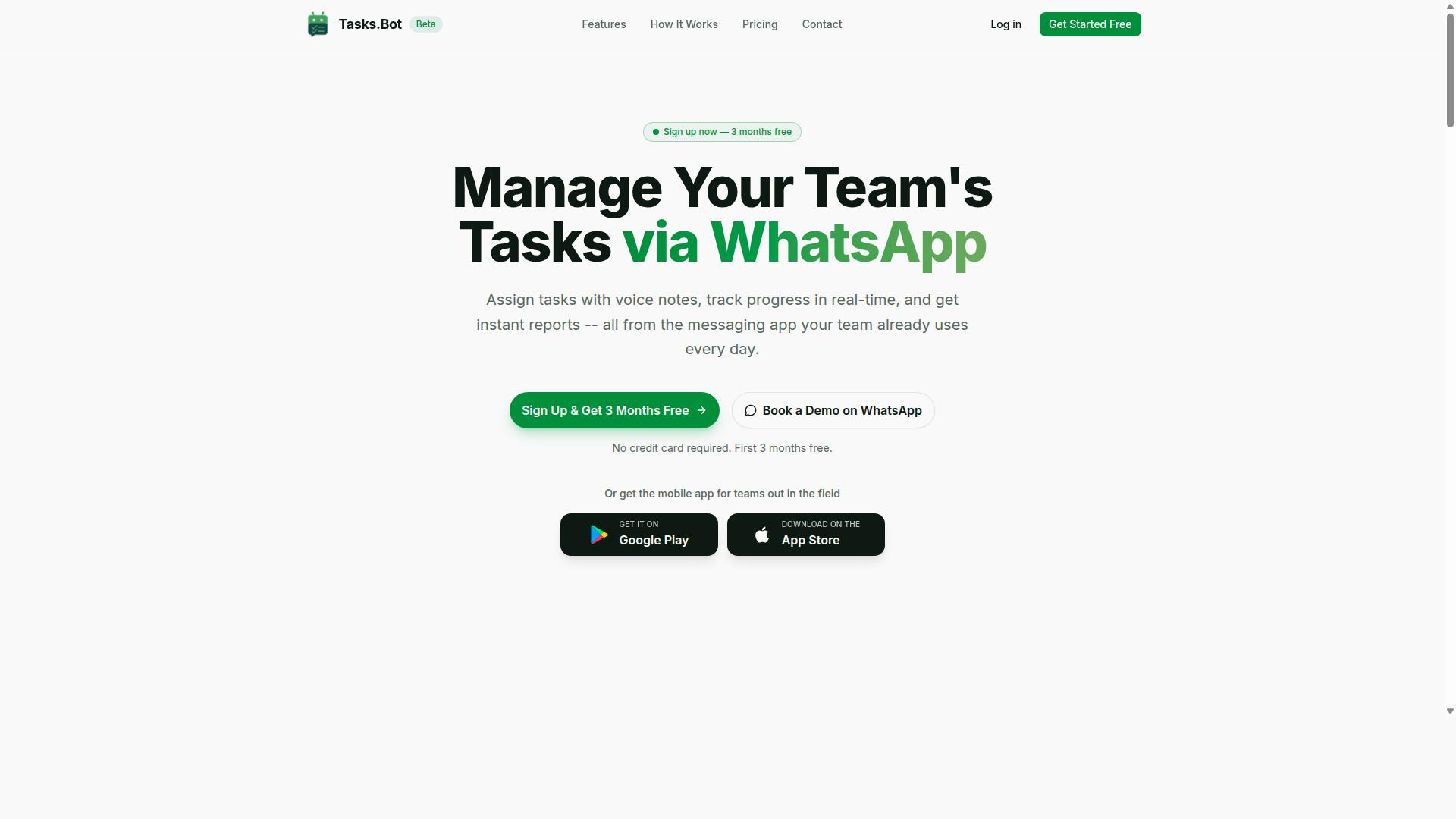
Tasks.Bot is a task management platform that operates entirely within WhatsApp, allowing teams to assign tasks, track progress, and receive reports without leaving the messaging app. Instead of asking people to learn a new tool, it meets them in a place they already check every day.
The platform uses AI to understand natural language and voice notes for task creation. A manager can describe what needs to happen in plain words or a quick voice message, and Tasks.Bot turns that into a structured task. No separate app install and no new account are required for team members to get started.
Beyond everyday task tracking, Tasks.Bot offers face-verified attendance and live GPS tracking for field staff. These features speak to a specific audience: teams that work outside an office and need proof of presence alongside their task lists.
Security is handled with enterprise-grade encryption. Conversations and task data are never shared or used for training, which matters for businesses that treat internal messages as sensitive. A mobile app is also available for field teams who need more than the chat interface.
The service is currently in beta and offers a free trial period. Tasks.Bot provides a 3-month free trial with no credit card required, so teams can evaluate whether WhatsApp-native task management fits how they already work.
How Tasks.Bot Differs From TaskRio for AI-Driven Task Creation
Unlike TaskRio, which typically requires users to adopt a separate platform or app, Tasks.Bot leverages WhatsApp to enable AI-driven task creation directly in the chat interface. That difference shapes everything from onboarding time to daily habits.
With TaskRio, the workflow usually starts by opening a dedicated tool, logging in, and building tasks inside that environment. Tasks.Bot skips that step. A user types a message or sends a voice note, and the AI interprets the request. There is no context switch between chatting with colleagues and managing work.
This matters most for adoption. Research suggests that new software often fails not because of missing features but because people never build the habit of opening it. Because Tasks.Bot lives inside a messaging app teams already use, the barrier to participation is lower. Field workers, in particular, may never need to touch a dashboard at all.
The AI layer adds another distinction. Tasks.Bot uses AI to understand context and assign tasks automatically, so instructions given in natural conversation become actionable items without manual data entry. TaskRio, as a standalone task management tool, generally expects users to structure that information themselves.
- Tasks.Bot: best for teams already coordinating on WhatsApp, especially field and mobile teams that want task automation without another login.
- TaskRio: better suited to teams that prefer a dedicated task management workspace and are comfortable adopting a separate platform.
Neither approach is universally right. The deciding question is simple: does your team want to go to their work, or have their work arrive where they already are?
Is Tasks.Bot the Better Choice for AI Agent Creation Software?
When evaluating Tasks.Bot as AI agent creation software, consider its strengths in automating task workflows within WhatsApp and its limitations for building complex autonomous agents.
Tasks.Bot is not a general-purpose agent builder. It does not offer a no-code canvas for wiring together multi-agent systems, and it is not designed for teams who want to connect LLM integration endpoints, custom plugins, or webhooks into a bespoke pipeline. What it does instead is narrower and more practical: it uses AI to understand user intent inside WhatsApp and turn messages into structured, assigned, tracked tasks.
So the right question is not whether Tasks.Bot can do everything an agent framework can. It is whether your team needs an agent builder at all, or whether it needs task automation that actually gets used.
Assess Tasks.Bot against three criteria:
- Input flexibility. Can team members create work without learning a new interface?
- Adoption cost. How much setup, training, and IT overhead does rollout require?
- Fit for field and frontline teams. Does it work for people who are mobile, not desk-bound?
If those criteria matter more to you than orchestrating autonomous agents, Tasks.Bot is a strong choice. The sections below examine its two defining capabilities in detail.
Natural Language and Voice Note Task Creation
Tasks.Bot uses AI to parse natural language and voice notes, allowing team members to create tasks by simply sending a WhatsApp message like 'Assign plumbing repair to John by Friday.'
The platform's AI reads the message, understands the intent behind it, and extracts the details that matter: who the task goes to, when it is due, and what needs to be done. Those details become a structured task rather than a loose chat message that gets buried in a thread.
Voice notes work the same way. A supervisor walking a site can speak a task out loud instead of typing it. That matters for anyone whose hands are busy or whose screen is hard to read in daylight.
This is a meaningful contrast with conventional agent creation software, where the value is usually in building logic, not in capturing work as it happens. Tasks.Bot inverts that priority. The conversational AI layer exists to remove friction at the moment of assignment, not to demonstrate orchestration.
Practical examples of what a message can carry:
- A task description, such as a repair or inspection
- An assignee, named directly in the message
- A deadline, expressed in everyday language
The benefit is speed. A task that might otherwise wait until someone opens a laptop and fills out a form gets created in seconds, by the person closest to the work. For teams already living in WhatsApp, that is task automation with almost no behavioral change required.
No New Apps or Accounts Required for Your Team
Tasks.Bot eliminates onboarding friction because team members don't need to install a new app or create separate accounts. They simply use WhatsApp, which they likely already have.
This is the platform's clearest structural advantage. Traditional task management tools typically require a download, a login, a password reset, and some amount of training before anyone completes a single task. Every one of those steps is a place where adoption stalls.
Tasks.Bot operates entirely within WhatsApp. The team keeps the interface they already know, and the software meets them there. For an operations lead, that means faster rollout and less IT overhead, since there is no app to distribute, provision, or support.
It also tends to raise compliance. When the tool lives in the app people already check throughout the day, tasks are more likely to be seen and acted on. A separate dashboard only works if someone remembers to open it.
Tasks.Bot works on any device that runs WhatsApp, which makes it a natural fit for field teams and less tech-savvy users. There is no desktop requirement and no learning curve tied to a new layout.
It is worth being precise about the trade-off. Tasks.Bot is not a general-purpose agent builder, and it does not try to be. For teams whose real problem is getting work assigned, tracked, and completed, that focus is the point. For teams whose goal is designing autonomous agents and multi-agent systems, a dedicated agent framework remains the better tool.
Judged on its own terms, Tasks.Bot is a strong choice. It brings AI-driven task creation to the channel your team already uses, with no new accounts to manage and no apps to install.
Key Features and What Makes Tasks.Bot Stand Out
Tasks.Bot offers a suite of features designed to streamline task management for teams that rely on WhatsApp, from automations and approvals to field-specific tools.
What sets the platform apart is its native WhatsApp integration. Instead of asking teams to adopt yet another dashboard, Tasks.Bot works inside the messaging app most people already use every day. Tasks can be created from voice notes, and the service uses AI to understand user intent and turn messages into structured tasks.
The feature set splits into two broad categories. The first covers workflow automation: automatic task assignment, approval chains, smart deadline reminders, and instant reports. The second covers tools built for field teams: GPS tracking, face-verified attendance, a live day tracker, and shifts, leave, and hours management.
Android and iOS apps round out the offering with push notifications, voice capture, and a home screen widget, so updates reach users wherever they are.
Automations, Approvals, and Smart Deadline Reminders
Tasks.Bot automates routine workflows with features like automatic task assignment, approval chains, and smart deadline reminders.
When a task is created, it can be auto-assigned rather than routed by hand. That removes the back-and-forth of deciding who owns what, which matters most for teams handling a steady volume of requests.
Approval chains add a layer of control. A task can require sign-off before it is marked complete, so managers keep visibility over work that needs verification. This suits project management teams coordinating handoffs, and field service operations where a job should not close until a supervisor confirms it.
Smart deadline reminders escalate as a due date approaches. Combined with instant reports, managers get a clearer picture of what is on track and what needs attention.
These automations matter because they reduce manual coordination. For teams already working in WhatsApp, the workflow automation happens in the same place the conversation does, with no separate tool to check.
Field Team Tools: GPS Tracking, Face-Verified Attendance, and Live Day Tracker
For teams with field staff, Tasks.Bot includes GPS tracking, face-verified attendance, and a live day tracker to monitor progress and ensure accountability.
GPS tracking confirms where field work is happening, giving managers location verification tied to the task at hand. Face-verified attendance records who is actually present, captured through the mobile app rather than a sign-in sheet or a colleague's word.
The live day tracker shows task status in real time, so a supervisor can see how the day is progressing without chasing phone calls. Attendance and task completion connect here: a worker's check-in and the work they finish live in the same system, not in separate spreadsheets.
Together these tools address common field problems. Location and identity checks reduce time theft, verified attendance supports accurate payroll hours, and live status gives managers better oversight across scattered sites. Shifts, leave, and hours management complete the picture for scheduling.
All of these features are available through the Tasks.Bot mobile app on Android and iOS, with push notifications and voice capture keeping field staff connected to the same task list their office colleagues use.
Pricing and Plans
Tasks.Bot offers a straightforward 'Full Access' plan with all features included, priced at ₹200 per member per month or ₹1,200 per member per year, with equivalent pricing in US Dollars.
That structure stands out for its simplicity. Many AI agent creation software platforms split capabilities across starter, pro, and enterprise tiers, which forces teams to guess which plan unlocks which capability. Tasks.Bot avoids that entirely by placing every feature under one plan. For anyone evaluating an agent builder, that removes a common source of budget uncertainty.
The monthly rate is ₹200 per member per month. The annual rate is ₹1,200 per member per year, which the brand presents as a 50% saving, or ₹1,200 saved per member annually. For a small team, that difference adds up quickly when several people need access to build and manage AI agents.
| Plan | Billing Cycle | Price per Member | Notes |
|---|---|---|---|
| Full Access | Monthly | ₹200 per month | All features included |
| Full Access | Annual | ₹1,200 per year | All features included; 50% saving, ₹1,200 saved per member per year |
Pricing is available in Indian Rupees and US Dollars. The site displays a 'Select currency' option with both choices, so it is worth confirming the currency during checkout to avoid confusion about the final amount.
New users also get 3 months free, with no credit card required and the ability to cancel anytime. That trial window gives teams room to explore the platform, test workflow automation, and decide whether it fits their needs before paying.
To see the plan in action, you can Book a Demo on WhatsApp. For teams comparing cost against value, the key point is that one flat price covers the full feature set, with no tiered upsells to factor into the decision.
Trust Signals: Beta Status, Encryption, and Teams Already Onboard
Tasks.Bot is currently in beta, which means it's actively evolving, but it already serves hundreds of teams and employs encryption to protect data. For anyone evaluating AI agent creation software, that combination matters more than a polished version number.
Beta status tells you two things at once. The platform is still being refined, and the team behind it is responsive to feedback from the people using it every day.
Encryption addresses the question that comes up first in any serious evaluation: is my data safe? When you build autonomous agents that connect to business systems, that concern is not abstract.
Hundreds of teams are already running Tasks.Bot. That is not a marketing claim pulled from thin air. It is a working signal that the platform handles real workloads for real organizations, even before general release.
The site also mentions a refund policy in the footer. A published refund policy is a small detail with outsized weight. It shows the vendor is willing to stand behind the product rather than lock buyers in.
Transparency about beta limitations is part of the same picture. A platform in active development may change, and features may shift as feedback comes in. Buyers who understand that upfront tend to have a smoother experience than those expecting a frozen, finished product.
For teams comparing options, the practical takeaway is straightforward. Beta status is a stage, not a red flag. Encryption, an existing user base, and a stated refund policy are the concrete signals worth weighing.
Who Should Use Tasks.Bot
Tasks.Bot is ideal for teams that already use WhatsApp for communication, especially those with field staff who need task management, attendance tracking, and payroll-ready hours. The platform is built around a simple idea: instead of asking workers to adopt another app, it meets them inside the messaging tool they already open every day.
According to the brand, hundreds of teams already use the service. That adoption pattern makes sense for organizations where staff spend more time on-site than at a desk, and where software that demands training or a new login tends to get abandoned within weeks.
Several groups fit this profile particularly well. They include:
- WhatsApp-based teams that already run day-to-day coordination through group chats and direct messages
- Field service teams whose work happens at client sites, job locations, or moving routes
- Small to medium businesses that want task oversight without a large software rollout
- Remote teams spread across locations who need a shared, lightweight way to stay aligned
In practical terms, that covers industries such as construction, where crews move between sites and need clear task assignment; maintenance, where jobs are logged as they happen; delivery, where routes and confirmations matter; and sales, where follow-ups and visit records pile up quickly.
The reason Tasks.Bot suits these groups comes down to how their staff already work. Voice notes replace long typed updates. Location data supports attendance and field verification. Because everything runs through WhatsApp, there is no new app to install and no separate system to learn. For teams that resisted earlier tools, that removal of friction is often the deciding factor.
Tasks.Bot also serves teams globally, so location is not a barrier to getting started. For a construction firm, a maintenance crew, a delivery operation, or a distributed sales team, the fit is straightforward: the people doing the work keep using the tool they know, while managers gain visibility into tasks, attendance, and hours that are ready for payroll.
Final Verdict
Tasks.Bot stands out as a practical AI-powered task management solution for WhatsApp-centric teams, though its beta status means it's still maturing. It is not trying to be a full AI agent creation platform. Instead, it focuses on doing one job well: turning conversations into organized, assignable work.
For teams comparing it against agent builders like TaskRio, the distinction matters. TaskRio leans toward building autonomous agents, multi-agent systems, and complex AI orchestration. Tasks.Bot applies AI to a narrower but very common need, task automation inside WhatsApp, which is where many field and operations teams already spend their day.
Key strengths center on fit rather than breadth. The WhatsApp integration sits at the core, so teams do not need to migrate to a new messaging tool. AI task creation reduces the manual step of logging work, and the field team tools support people who are mobile rather than desk-bound. Pricing is kept simple, which lowers the barrier for small and mid-sized teams testing AI-driven workflows.
Limitations are worth stating plainly. The product is in beta, so features and stability may still evolve. It is not a full agent builder, meaning it does not cover agent frameworks, LLM integration choices, or custom agent deployment. Its scope stays within task management rather than broad workflow automation or API connectivity for building autonomous agents.
The right recommendation depends on the goal. If a team is already on WhatsApp and needs task automation, Tasks.Bot is a strong, focused choice. If the goal is building custom agents, pipelines, or multi-agent systems, a dedicated agent builder is the better path. Tasks.Bot wins on simplicity and relevance, not on being everything to everyone.
To learn more or book a demo, contact the team by phone at +91 97143 42522 or email [email protected].
Frequently Asked Questions
What is the main difference between Tasks.Bot and TaskRio for AI agent creation?
Tasks.Bot is a task management platform that runs entirely inside WhatsApp, using AI to understand natural language and voice notes so teams can create and assign tasks without installing anything or creating new accounts. Rather than positioning itself as a general AI agent builder, Tasks.Bot focuses on practical, everyday team workflows like task assignment, approvals, automations, attendance, and instant reports. If you're comparing it to TaskRio, the key question is whether you need a broad agent-creation tool or a ready-to-use WhatsApp-based task system your team can adopt immediately.
Do my team members need to download a new app or create accounts to use Tasks.Bot?
No. Tasks.Bot operates entirely within WhatsApp, so team members don't need to install anything or create new accounts - they simply work from the messaging app they already use. There is also a mobile app available for field teams who need additional functionality. This makes onboarding much simpler compared to platforms that require every user to sign up and learn a new interface.
How does Tasks.Bot's AI handle task creation compared to other tools?
Tasks.Bot uses AI to understand natural language and voice notes, so you can create tasks the way you'd naturally message a colleague instead of filling out complex forms. The platform also supports automatic task assignment, smart deadline reminders, approvals, and automations. This approach is designed for speed and accessibility, especially for teams that communicate primarily through WhatsApp.
What features does Tasks.Bot offer for field teams?
Tasks.Bot includes tasks on a map, live day tracking, face-verified attendance, and payroll-ready hours - features built with field staff in mind. These are combined with instant reports and smart deadline reminders so managers can stay informed without chasing updates. It's aimed at teams that use WhatsApp for communication and need task management, attendance tracking, and reporting in one place.
How much does Tasks.Bot cost, and is there a free trial?
Tasks.Bot offers a 'Full Access' plan with all features included. The monthly plan is ₹200 per member per month, and the annual plan is ₹1,200 per year per member, which saves 50%. Pricing is available in both Indian Rupees and US Dollars. The service is currently in beta, and the site mentions a refund policy in the footer - for the latest details, it's best to reach out directly.
Is Tasks.Bot available in my country, and how can I get started?
Yes - Tasks.Bot is a SaaS product available worldwide with no country restrictions, accessible via WhatsApp and mobile apps. You can get started by booking a demo on WhatsApp directly from the website. For questions, you can also contact the team at [email protected] or +91 97143 42522.
Recommended Resources: