7 Abun Alternatives Autoblogging Mistakes to Avoid
You searched for an Abun alternative and landed on seven mistakes instead. That detour costs you drafts, credits, and rankings you cannot recover. Some tools promise volume, then leave you editing every paragraph by hand.
This article explains what Autoblogging.ai actually does, who it serves, and why chasing tool names leads bloggers astray. You will learn the seven mistakes that sink autoblogging results, from publishing unedited AI drafts to ignoring rollover economics, so you can judge any provider on workflow, not hype.
What Is Autoblogging.ai?
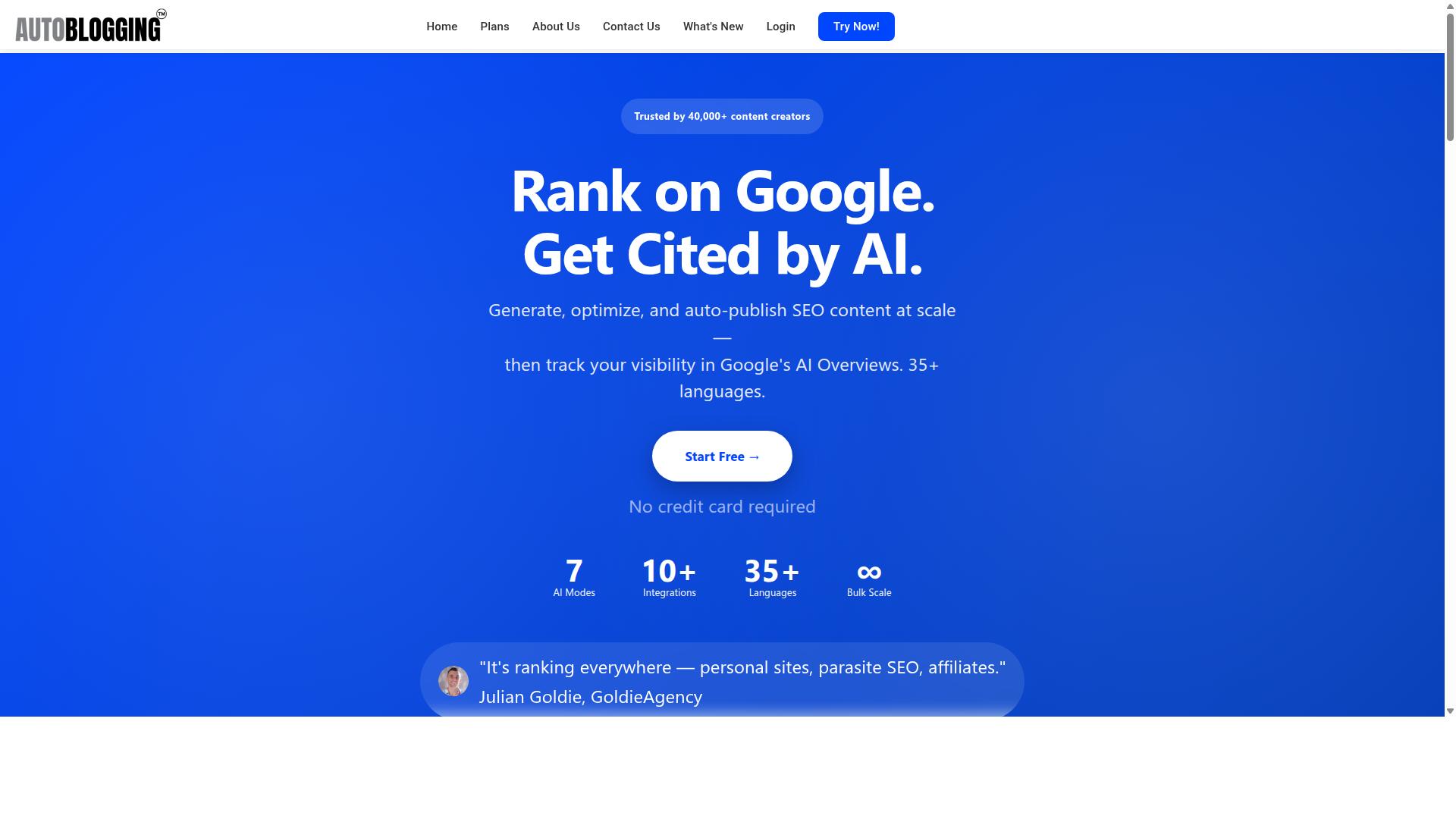
Autoblogging.ai is an AI-powered platform that generates and publishes articles automatically, designed to streamline content creation for websites and blogs. Instead of drafting every post by hand, users can rely on AI content generation paired with automated publishing to keep a site active without a full-time writing team.
The tool is a product of Digimetriq.com. Its stated mission is to help bloggers, website owners, and agencies save time and improve their online presence through cutting-edge technology. That goal shapes everything the platform does, from how articles are produced to how they reach a live site.
Autoblogging.ai also aims to cut down content costs and to enable human counterparts within standard operating procedures with the first draft. In other words, the tool is built to handle the heavy lifting of a first version, while people stay in the loop to refine and approve. Digimetriq, the company behind it, has a broader ambition to replace human counterparts entirely.
This matters for anyone researching Abun alternatives and the autoblogging mistakes to avoid. Understanding what the platform actually is, an article generation and automated publishing system, sets a clear baseline. From there, readers can judge how content automation fits into SEO, keyword research, and niche relevance without falling into the traps of duplicate content, thin content, or indexing issues.
Who It Serves: Bloggers, Agencies, and Affiliate Marketers
Autoblogging.ai serves a diverse range of content creators, including individual bloggers, marketing agencies, and affiliate marketers who need to scale content production efficiently. The platform's audience also covers website owners, SEO professionals, and content creators of many stripes.
Different users come with different needs, and the tool's positioning reflects that spread:
- Bloggers running personal sites can keep a steady publishing rhythm without writing every post from scratch.
- Website owners managing portfolio sites or local sites get help filling out pages and posts that would otherwise sit empty.
- SEO professionals can support keyword research and search intent coverage across multiple projects.
- Marketing agencies juggling client websites benefit from producing first drafts at a volume that manual writing rarely matches.
- Affiliate marketers building affiliate sites can expand niche content faster, which matters when scaling a portfolio.
- Content creators exploring parasite SEO and similar tactics gain a way to publish across more surfaces.
The common thread is volume plus time pressure. A solo blogger may want to post weekly without burning weekends, while an agency may need drafts for several client sites in the same week. Affiliate marketers often run multiple niche sites at once, where content gaps directly affect visibility.
By cutting down content costs and supplying a first draft that humans can refine, Autoblogging.ai fits into workflows where editing, readability checks, and E-E-A-T considerations still matter. That balance between automation and human review is exactly where many autoblogging mistakes, from thin content to neglected internal linking, tend to surface.
Why "Abun Alternatives" Searches Lead Bloggers Astray
Searching for "Abun alternatives" often leads bloggers to a maze of tools that promise similar features but fail to address the underlying workflow and quality issues that determine success. The term "Abun" likely refers to a specific tool or method that gained traction in autoblogging circles, and when users hit a wall with it, their first instinct is to find a replacement rather than diagnose the real problem.
That instinct is understandable but misguided. Switching from one AI content generation platform to another rarely fixes thin content, poor keyword research, or a broken publishing schedule. The tool changes; the mistakes stay.
Most bloggers assume the software is the bottleneck. In reality, the bottleneck is usually the strategy behind it. A blogger who publishes unedited AI drafts on a new platform will produce the same weak results they got on the old one, just with a different dashboard.
This matters because autoblogging involves several moving parts: keyword research, content quality, readability, search intent alignment, automated publishing, and technical SEO. A tool only handles part of that chain. If the rest of the chain is broken, no alternative will rescue the outcome.
There is also a discovery problem. Many "Abun alternatives" lists are written to capture search traffic, not to give honest guidance. They rank tools by affiliate payout rather than by fit. Bloggers then bounce between platforms, burning time and money without ever building a repeatable system.
The smarter approach is to flip the question. Instead of asking "what replaces Abun," ask "what mistakes am I making that make any tool underperform?" Once those mistakes are visible, choosing a platform becomes far easier, and far less frequent. The seven errors below cover the ones that show up again and again.
The 7 Mistakes That Sink Autoblogging Results
From chasing shiny tools to ignoring SEO fundamentals, these seven mistakes consistently undermine autoblogging efforts and prevent sustainable growth. Each one is common, each one is fixable, and each one costs more than most bloggers realize until traffic stalls.
Here is the short version before the detailed breakdown:
- Chasing tools over workflow. Buying a new platform before defining how content moves from idea to published post.
- Publishing unedited AI drafts. Skipping human editing and letting raw output go live without review.
- Ignoring SERP and semantic SEO. Writing without checking what already ranks or what related terms searchers expect.
- Scaling volume before quality. Flooding a site with hundreds of posts before any single post proves it can earn traffic.
- Overlooking pricing and credits. Getting surprised by credit limits, overage fees, or plans that do not match actual publishing frequency.
- Skipping integration and automation. Failing to connect the tool to a WordPress plugin, scheduling system, or RSS and API workflow.
- Trusting unverified tools. Adopting platforms without checking plagiarism handling, AI detection transparency, or real user feedback.
Notice that only two of the seven are really about the tool itself. The other five are about decisions the blogger makes before and after opening the software. That ratio is the whole point of this article. Fix the decisions, and the tool question mostly answers itself.
Each mistake below gets its own section, with practical signs to watch for and concrete steps to avoid it. Read them in order if you are starting fresh, or jump to the one that matches your current frustration.
Mistake 1: Chasing Tools Instead of a Repeatable Content Workflow
Many bloggers jump from one AI tool to another, hoping for a magic solution, but without a repeatable workflow, they end up with inconsistent results and wasted effort. The tool changes every few months. The process behind the content never gets the chance to mature.
This is one of the most common autoblogging mistakes people make when they leave Abun or any similar platform. They treat every new AI content generation product as a replacement for strategy, not as a piece of a larger system.
A documented workflow removes guesswork. It also makes results repeatable, which is what separates a hobby blog from a publishing operation.
A practical content workflow usually covers six stages:
- Ideation: deciding which topics deserve coverage based on audience needs
- Keyword research: mapping terms to search intent and niche relevance
- Drafting: producing a first version fast enough to keep momentum
- Editing: tightening readability, accuracy, and user intent alignment
- Publishing: handling title tags, meta descriptions, H1 tags, schema markup, and XML sitemap updates
- Promotion: building backlinks, internal linking, and anchor text distribution
Tool-hopping breaks this chain. Each switch resets your templates, your prompts, and your publishing habits. The blog ends up with mixed formatting, uneven depth, and gaps in internal linking that hurt SEO over time.
Autoblogging.ai fits into a structured process rather than replacing it. Its Quick Mode suits the drafting stage when speed matters. Godlike Mode handles the optimization layer, with SERP competitor analysis, LSI keywords, and knowledge graph extraction feeding into a stronger second pass.
Other stages map just as cleanly. Semantic SEO Analysis offers a 21-point audit for the editing phase. Topical Maps and Fan Out Queries support keyword research and content planning. For publishing, the WordPress integration covers unlimited sites with one-click posting, a plugin, and scheduled auto-posting, which keeps the final step consistent instead of manual.
Bulk Generation can produce up to 500 articles via CSV when volume is part of the plan. News Mode and Amazon Reviews Mode serve narrower formats. None of these features decide your strategy. They execute steps you have already defined.
The distinction matters. A tool is an enabler. A workflow is the strategy. Bloggers who document their process first, then choose tools that fit each stage, avoid the cycle of constant switching and see steadier output.
Before adopting any Abun alternative, write down your six stages and assign a tool to each one. If a platform cannot support drafting, optimization, and automated publishing without forcing you to rebuild your process, it is not the right fit. Autoblogging.ai is built to slot into that structure, not to replace the thinking behind it.
Mistake 2: Publishing Unedited AI Drafts Without a Human Pass
Publishing raw AI output without human editing risks thin content, factual errors, and penalties, as search engines prioritize experience, expertise, authoritativeness, and trustworthiness (E-E-A-T).
AI content generation has matured quickly, and modern tools can produce a coherent draft in seconds. That speed is exactly what makes this mistake so common. It is tempting to treat a generated draft as a finished article, schedule it, and move on to the next post.
The problem is that a draft is not a finished article. Search engines evaluate content quality, readability, and user intent signals, and an unedited AI draft often falls short on all three. Human editing is what turns a draft into a publishable asset.
Even advanced AI like Autoblogging.ai's Godlike Mode requires a human touch for best results. That is not a weakness of the tool. It reflects how E-E-A-T works: experience and trustworthiness come from a real person who understands the niche, the audience, and the claims being made.
Autoblogging.ai includes a human proofreader in all plans, which shows the platform treats review as part of the workflow rather than an afterthought. The tool provides the draft and the structure. The editor provides judgment.
Here is a practical checklist for the editing pass before anything goes live:
- Fact-check every claim. Verify names, numbers, dates, and product details against a primary source. AI can state incorrect information with complete confidence.
- Add first-hand examples. Insert a real scenario, a customer story, or a lesson from experience. This is the fastest way to demonstrate genuine expertise.
- Fix AI quirks. Look for repetitive phrasing, awkward transitions, and generic filler sentences that add no information.
- Improve flow and readability. Break up long paragraphs, vary sentence length, and make sure the piece reads naturally aloud.
- Check search intent alignment. Confirm the article actually answers the query that brought the reader there, not a related but different question.
- Remove duplicate or thin sections. Cut anything that restates a previous point in different words.
- Review headings and structure. Ensure H1 and subheadings are logical, descriptive, and free of keyword stuffing.
- Verify internal and external references. Check that cited sources exist and that internal links point to relevant pages.
This pass does not need to take hours. For a typical post, a focused review of fifteen to thirty minutes catches the majority of issues. That investment protects the site from thin content flags, factual embarrassment, and lost rankings.
Teams that scale content automation successfully treat the human edit as a fixed step in the pipeline, not an optional one. The draft is the raw material. The editor is the quality gate.
Mistake 3: Ignoring SERP and Semantic SEO Signals
Ignoring SERP analysis and semantic SEO signals leads to content that misses user intent, resulting in poor rankings and wasted effort. When you publish without checking what already ranks, you are essentially guessing at what readers and search engines want.
This mistake shows up in two forms: content that answers a different question than the one being searched, and content that covers a topic too thinly to compete. Both problems trace back to skipping the research stage entirely.
Fixing it starts with studying the search results page before writing a single word. The steps below outline a practical process.
- Study the top-ranking pages. Review the titles, headings, and formats of pages already ranking for your target query. Note whether the results favor how-to guides, listicles, comparisons, or product pages.
- Identify content gaps. Look for subtopics, questions, or angles the current results handle poorly. Those gaps are where new content can earn visibility.
- Extract entities and knowledge graph elements. Search engines connect topics through entities like people, places, products, and concepts. Naming the relevant entities helps content align with how machines understand a subject.
- Add LSI and related keywords. Latent semantic indexing terms are the naturally connected phrases a thorough article tends to include. They signal topical depth without keyword stuffing.
- Structure for featured snippets. Use clear question-based headings, concise direct answers, and well-formatted lists or tables where a snippet is likely to appear.
Semantic structure also means clean heading hierarchy, logical internal linking, and supporting elements like schema markup where relevant. These signals help search engines parse the page and understand its relationship to a broader topic cluster.
Autoblogging.ai addresses this mistake directly through its Godlike Mode, which performs SERP competitor analysis, LSI keyword extraction, and knowledge graph extraction. Instead of leaving this research to guesswork, the mode builds it into the article generation process.
The platform also offers a Semantic SEO Analysis tool, a 21-point audit, along with a Snippet Optimizer, Topical Maps, Fan Out Queries, and an Intense Optimizer. Together these tools support the kind of semantic depth that thin, un-researched content cannot match.
For anyone weighing Abun alternatives, this is a meaningful distinction. Content automation only pays off when the output is built on real search data rather than assumptions about what might rank.
Mistake 4: Scaling Volume Before Quality Is Proven
Scaling content volume before establishing quality leads to duplicate, thin content that can trigger Google penalties and dilute site authority. It is one of the most common traps in autoblogging, and it is entirely avoidable with a measured approach.
When publishers rush to push out hundreds of posts at once, several problems surface quickly. Thin content offers little value to readers and rarely ranks. Duplicate content across pages confuses search engines about which version to show. Both issues waste crawl budget, meaning Google spends time on low-value URLs instead of your best pages.
Indexing issues follow close behind. If a large batch of pages is published before quality checks, many may never get indexed at all, or they get indexed and then quietly dropped. That undermines the SEO value of the whole site.
Autoblogging.ai's Bulk Generation feature can produce up to 500 articles via CSV upload. That capacity is genuinely useful, but it should be treated as a scaling tool, not a starting point. The smarter path is to generate a small batch first, review readability, search intent alignment, and factual accuracy, then refine your prompts and settings before expanding.
A quality-first workflow looks like this:
- Start with a small test batch and publish it.
- Measure indexing, rankings, and engagement over time.
- Refine templates, keyword targeting, and editing standards.
- Scale volume only once the early results hold up.
Tools like the Semantic SEO Analysis 21-point audit and the AI Proofreader can support quality control at each stage, but the discipline of checking before scaling has to come from the publisher. Volume amplifies whatever quality level you already have, good or bad.
Mistake 5: Overlooking Pricing, Credits, and Rollover Economics
Overlooking pricing structures, credit consumption, and rollover policies can lead to unexpected costs and inefficient use of AI content tools. Many buyers compare headline prices only, then discover their plan runs dry mid-month while unused credits from a quiet month simply vanish. Both problems are avoidable with a little planning.
In AI content generation, a credit is the unit that pays for one generated article or task. How many credits a piece of content consumes typically depends on length and complexity, so a short news-style post and a long, heavily researched guide are rarely priced the same. That is why a plan's raw credit count matters less than whether it matches your real content automation output.
Rollover is the quiet cost saver. If your publishing schedule varies, say ten articles one month and forty the next, credits that carry forward prevent you from paying twice for the same capacity. Without rollover, slow months waste money and busy months force top-up purchases.
Autoblogging.ai addresses this directly: all plans include credits rollover. New accounts also receive 10 free credits per month with no credit card required, which is a low-risk way to gauge how far a credit stretches before committing.
Here is how the monthly plans compare:
| Plan | Monthly Price | Credits |
|---|---|---|
| Starter | $19 | 40 credits |
| Regular | $49 | 120 credits |
| Standard | $99 | 300 credits |
| Gold | $179 | 600 credits |
| Premium | $249 | 1,000 credits |
| Enterprise | $999 | 5,000 credits |
Annual billing lowers the effective rate. Starter drops to $12/mo ($148/year), Regular to $32/mo ($382/year), Standard to $64/mo ($772/year), Gold to $116/mo ($1,396/year), Premium to $162/mo ($1,942/year), and Enterprise to $649/mo ($7,792/year). Additional credits can be purchased when demand spikes, and payment options include Visa, MasterCard, American Express, and PayPal, with bank transfers available for annual enterprise plans via Stripe. Cancellation is allowed anytime.
To estimate your needs, work backward from volume and complexity:
- Count the articles you genuinely plan to publish each month across every site.
- Note how many are long-form or research-heavy versus short updates, since complexity drives credit use.
- Add a buffer for seasonal pushes, product launches, or new niche sites.
- Check whether unused credits roll over before choosing a tier.
For teams that prefer not to manage credits at all, Autoblogging.ai also offers Done For You packages: Starter at $1,200 for 1,000 articles, Pro at $1,600 for 1,000 articles, Corp at $4,000 for 1,000 articles, and Senpai at $10,000 for 1,000 articles. The right choice comes down to whether you want to run the automated publishing workflow yourself or hand it off entirely.
The mistake to avoid is treating pricing as a one-time comparison. Match the plan to your actual frequency and volume, confirm rollover is included, and revisit the tier as your portfolio grows. Autoblogging.ai's rollover on every plan, plus its free starting credits, makes that alignment straightforward rather than a guessing game.
Mistake 6: Skipping Integration and Publishing Automation
Skipping integration and publishing automation means missing out on the core benefit of autoblogging: saving time through seamless content deployment. Generating articles is only half the job. If you still copy, paste, and upload every post by hand, you have rebuilt the manual workflow that autoblogging was supposed to eliminate.
This mistake usually shows up in two ways. Some users never connect their generator to a publishing destination at all. Others connect it once but leave scheduling switched off, so output depends on someone remembering to hit publish. Both patterns create the same result: inconsistent publishing and wasted hours.
Autoblogging.ai addresses this directly. It supports WordPress integration across unlimited sites, including one-click publishing, a plugin, and scheduled auto-posting. It also connects to Web 2.0 platforms like Medium, Dev.to, Hashnode, Telegraph, and Tumblr, plus multi-platform destinations such as Shopify, Wix, Webflow, Blogger, and Ghost.
For custom workflows, there is API access along with Zapier and n8n support. If you prefer a hands-off route, Done For You packages are available. Altogether, Autoblogging.ai offers 35+ integrations, which means most common publishing stacks are covered without custom development.
Manual deployment also hurts SEO. Search engines reward steady, predictable publishing, and gaps in your schedule can slow how quickly new pages get crawled. Automation keeps your XML sitemap and RSS feeds active, which supports indexing and crawl budget efficiency over time.
Practical examples of what automation looks like:
- Scheduling posts to go live at set intervals instead of publishing in bursts
- Auto-publishing finished articles straight to WordPress without manual uploads
- Using the API to route content into a custom workflow or internal tool
- Connecting Zapier or n8n to trigger related tasks when a post goes live
Before generating at volume, decide where content will live and how it will get there. Map your destinations, connect them once, then set a publishing schedule that matches your capacity to review quality. Consistency beats volume every time.
Autoblogging.ai is a legitimate AI article generation platform built for exactly this purpose, serving bloggers, affiliate marketers, agencies, and site owners who need content at scale. Its integration and automated publishing layer is what turns article generation into true content automation. Skipping that layer is not a shortcut. It is the most common way people pay for an autoblogging tool and still end up working like they never bought one.
Mistake 7: Trusting Unverified Tools Over Track-Record Providers
Trusting unverified tools over providers with a proven track record can result in unreliable output, poor support, and wasted resources. This mistake is easy to make because every new autoblogging tool launches with confident marketing language. The signals that separate a dependable platform from a risky one are quieter, and they take a few minutes to check.
Start with user reviews and case studies. Look for feedback that describes real workflows: how the tool handled automated publishing, how it performed on SEO tasks, and whether support responded when something broke. A handful of glowing quotes on a sales page proves little. Patterns across independent review sites prove much more.
Next, examine longevity and transparency. A tool that has operated for years has survived algorithm updates, platform changes, and shifting expectations around AI content generation. Clear pricing, named features, and an accessible support policy are also positive signs.
Watch for red flags before committing:
- No verifiable testimonials or case studies anywhere online
- Pricing that stays vague until you book a call or enter payment details
- Feature lists that promise everything without explaining anything
- No visible update history or changelog
- Support channels that are hard to find or slow to respond
None of these guarantees failure on their own, but together they point to a provider that may disappear or underdeliver. A track record you can verify is the simplest protection against that outcome.
How Autoblogging.ai's 40,000+ Users and 1M+ Articles Compare
With over 40,000 users and more than 1 million articles generated, Autoblogging.ai demonstrates a level of adoption and output that sets it apart from unverified alternatives. Those numbers are not marketing abstractions. They represent content creators who kept using the platform long enough to produce real volume.
The platform also holds a 4.9 average rating, which matters because ratings reflect sustained experience rather than first impressions. Unverified tools rarely accumulate this kind of feedback at scale, simply because they have not been around long enough or have not retained enough users.
Breadth is another differentiator. Autoblogging.ai offers:
- 10+ AI modes for different content needs
- 35+ languages for multilingual publishing
- 35+ integrations for connecting existing workflows
- One-click WordPress publish
- A human proofreader included in all plans
- 24/7 support
Industry voices like Julian Goldie and James Dooley have shared testimonials endorsing the platform, adding third-party credibility that anonymous tools cannot match. Features like SERP competitor analysis, semantic SEO tools, a 21-point SEO audit, and featured snippet optimization also show a product built around search performance, not just text output.
Compare that to a typical unverified tool: no published user count, no named advocates, no proofreader, and no clear support commitment. When you weigh the two side by side, the safer choice for anyone serious about content automation is obvious. Autoblogging.ai has the adoption, the ratings, and the feature depth to justify trust, and that track record is exactly what this mistake warns against overlooking.
Final Verdict: Avoiding These Mistakes with Autoblogging.ai
Avoiding the seven mistakes outlined requires a combination of strategic workflow, quality control, and reliable tooling, areas where Autoblogging.ai provides a comprehensive solution. Each pitfall discussed earlier maps to a specific capability the platform was built to handle.
Poor workflow integration is addressed through API integration and scheduling options that connect content generation to a publishing pipeline. Instead of manual copy-paste routines, users can align output with cron jobs and frequency settings that suit their site.
Weak SERP awareness is where Godlike Mode comes in. This feature supports SERP analysis, helping users understand what search results already look like before committing to a topic or angle. That directly reduces the risk of missing search intent or producing content that ignores what already ranks.
Quality concerns are handled on two fronts. The platform generates at scale, yet keeps quality in view, and it supports human editing so a person can refine tone, readability, and accuracy before anything goes live. This combination tackles thin content, duplicate content, and AI detection worries in one pass.
Cost transparency matters too. Autoblogging.ai uses transparent pricing with rollover, meaning unused capacity is not simply lost. For teams watching budgets, that removes the pressure to over-generate just to feel they got value.
Integration breadth supports the technical side of SEO. Extensive integrations help with publishing and connected workflows, which supports cleaner indexing, sitemap handling, and internal linking structures over time.
The platform also brings a proven track record, which matters when choosing between Abun alternatives. A tool with a history of real usage is easier to trust than an unproven newcomer, especially for long-term content automation.
Here is how each mistake maps to a fix:
- Weak workflow integration: API integration and scheduling options
- Ignoring SERP context: Godlike Mode for SERP analysis
- Publishing unedited output: human editing support
- Thin or duplicate content: quality-focused generation at scale
- Unclear costs: transparent pricing with rollover
- Limited tooling: extensive integrations
- Uncertain reliability: a proven track record
If you want to discuss setup, pricing, or workflow questions directly, the team is reachable through several channels. Autoblogging.ai operates globally, with contact points in both India and the United Kingdom.
India office: 501, Trinity Orion, Vesu, Surat - 395007, Gujarat, India.
Phone/WhatsApp: +91 84605-06553 or +91-8460506553.
Email: [email protected]
Skype: vibes.yb
Availability: 7:00-19:00 IST.
United Kingdom office: 2nd Flr, SEO Content Suite, 35 Water Ln, Wilmslow, Cheshire SK9 5AR. Phone: +44 1625 359056.
You can also follow updates on Facebook, Twitter, and LinkedIn. Reaching out with specific questions about your niche, volume, or publishing setup is the fastest way to confirm whether the platform fits your goals.
The verdict is straightforward. The seven mistakes are avoidable, and Autoblogging.ai addresses each one through workflow integration, SERP analysis via Godlike Mode, human editing support, scalable quality-focused generation, transparent pricing with rollover, extensive integrations, and a proven track record. For anyone weighing Abun alternatives, that combination makes Autoblogging.ai a credible, well-supported choice.
Frequently Asked Questions
What are the most common mistakes people make with autoblogging?
The most common mistakes are publishing AI content without any review, over-optimizing for keywords at the expense of readability, and generating content at scale without a clear content plan. Others include ignoring internal linking, skipping fact-checking, and treating autoblogging as a fully hands-off "set and forget" process. Avoiding these usually comes down to combining automation with human oversight and a defined strategy.
How does Autoblogging.ai help me avoid these mistakes?
Autoblogging.ai offers 10+ AI modes, including Godlike Mode, which analyzes SERP competitors, extracts LSI keywords and pulls from knowledge graphs to produce more relevant content. It also includes a human proofreader in certain plans, so output isn't published blindly. With 35+ languages and 35+ integrations, you can fit generated content into an existing workflow rather than bolting it on.
Is Autoblogging.ai suitable for beginners, or is it only for agencies?
It's built for a broad audience: bloggers, website owners, SEO professionals, marketing agencies, content creators and affiliate marketers. Quick Mode is free and supports single and wizard-based generation, making it an easy entry point if you're new. As you scale, Bulk Generation (up to 500 articles via CSV) and higher-tier plans support agency-level output.
How much does Autoblogging.ai cost, and do unused credits carry over?
Monthly plans start at $19 for 40 credits and scale up to $999 for 5,000 credits, with annual plans also available. Credits roll over, so unused credits aren't wasted between billing periods. If you're unsure which tier fits, start smaller and upgrade as your content needs grow.
Can I generate content in bulk without sacrificing quality?
Bulk Generation supports up to 500 articles via CSV, which is ideal for scaling. To protect quality, pair bulk output with review workflows and use higher-quality modes like Godlike Mode for your most important pages. Autoblogging.ai also ships new features weekly and offers 24/7 support if you hit issues mid-campaign.
How do I know Autoblogging.ai is reliable enough to trust with my content?
Autoblogging.ai is trusted by 40,000+ content creators, holds a 4.9 average rating, and has generated over 1M articles. It's a product of Digimetriq.com, founded by Vaibhav Sharda in 2022, building on automation processes developed since 2011. You can reach the team via email at [email protected] or by phone/WhatsApp at +91 84605-06553.
Recommended Resources: